Every November, the same thing happens across Pittsburgh. The leaves come down, and a gray paper ball the size of a football suddenly shows up in a maple, a hedge or under the eave of a house. That is a bald-faced hornet nest, and it was almost certainly there all summer, hidden by the leaves.
The good news is that by the time most people spot one, the colony is dying off and the nest will never be used again. Here is how to tell what you are looking at, what to do with it now, and what to watch for next summer. If a nest is in a spot you cannot avoid while it is still active, that is the job our bee and wasp removal in Pittsburgh is for.
What a bald-faced hornet nest looks like
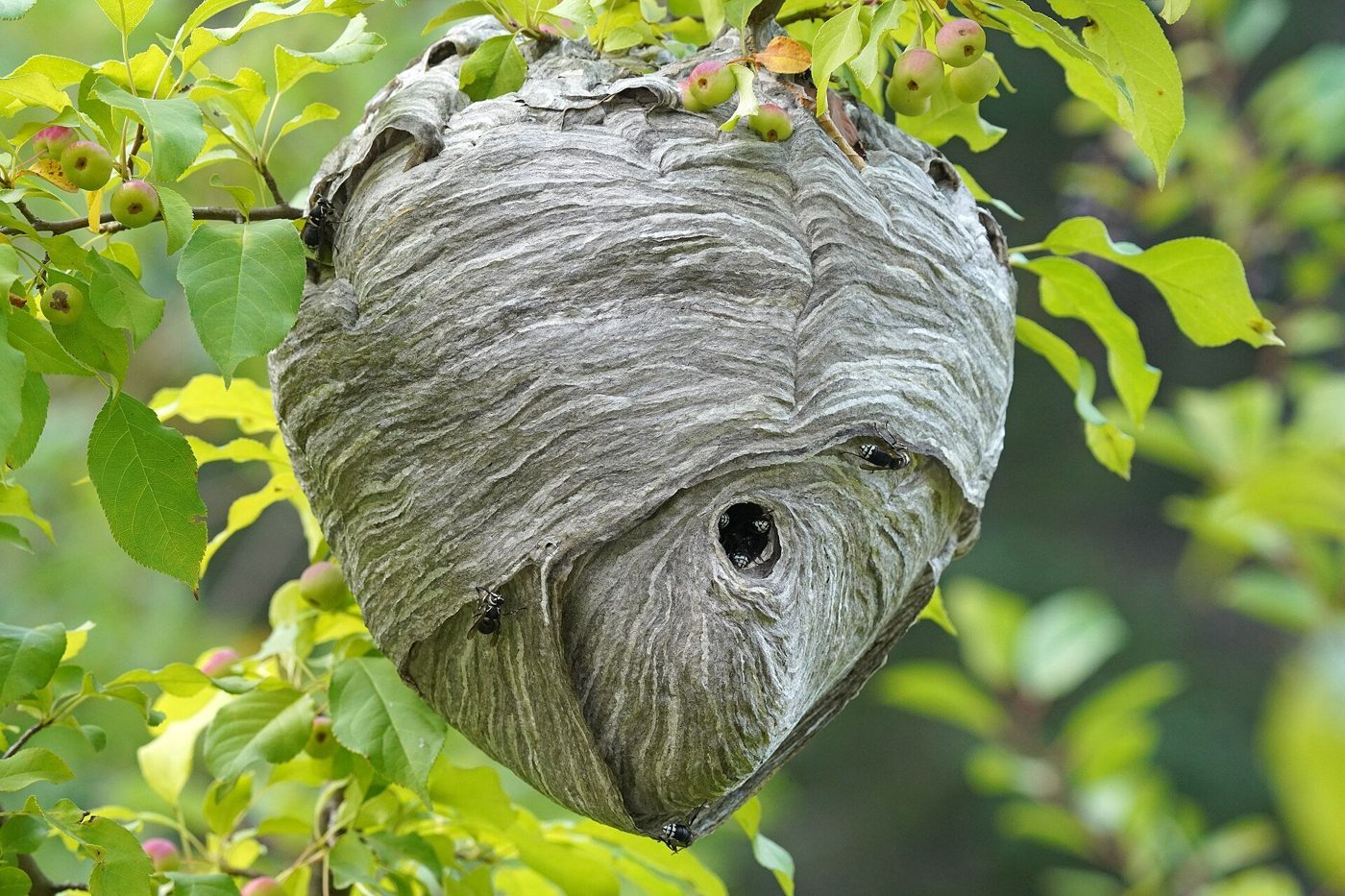
A bald-faced hornet nest is an enclosed paper shell, usually round or shaped like an upside down teardrop or football. The outside is gray with wavy bands of slightly different shades, because the workers build it from wood fiber they chew up and mix with saliva, often scraped from weathered fences, decks and dead branches.
A few traits set it apart from other nests you might find around the yard.
- It hangs in the open. Penn State Extension says nests are usually in bushes or shrubs at least three feet off the ground, or in trees as high as 60 feet or more.
- It is fully wrapped. Unlike a paper wasp nest, which is a single open comb, the combs are hidden inside layers of paper.
- It can get big. In Pennsylvania, Penn State reports nests reaching up to 24 inches tall and 18 inches across by the end of the season.
- There is one entrance. It is usually a single hole near the bottom.
A bald-faced hornet nest hanging in a shrub. Nests like this are built in spring and summer and often go unnoticed until the leaves drop.
Bald-faced hornets are really yellowjackets
Despite the name, the bald-faced hornet (Dolichovespula maculata) is not a true hornet. It is an aerial yellowjacket, a close relative of the yellowjackets that nest in the ground and crash cookouts in August, and Penn State notes the queen is usually the largest yellowjacket in the colony. The name comes from its look: a mostly black body with a largely white face.
Like other yellowjackets, bald-faced hornets are social. A colony is started each spring by a single queen who survived the winter. She builds a few cells, raises the first workers, and from then on the workers take over building, hunting and defense. Penn State puts a colony at roughly 100 to 400 workers by late summer.
They are also beneficial. Workers hunt flies and other insects, including other yellowjackets, to feed the young. That is why a nest high in a tree and well away from people is often best left alone. The trouble is that they defend the nest hard. Workers pour out when a nest is bumped or shaken, and unlike a honey bee, a hornet can sting more than once. If you have seen how yellowjackets get more aggressive in late summer, the same pattern applies here.
Why you are finding the nest in November
The nest did not appear overnight. It was built from late spring through summer, often in a tree or shrub you walked past every day. Once the leaves fall, it is suddenly obvious.
By then, the colony is near the end of its life. Here is what happens in fall:
- Late in the season the colony raises males and new queens instead of more workers.
- The new queens mate and leave the nest to find a sheltered spot for winter, such as hollow trees, rock piles, loose bark, or the walls and attics of buildings.
- The old queen, the workers and the males die. Penn State says most of the colony dies before or shortly after the first hard frost.
- The nest is left empty. Social wasp colonies last a single season, and old nests are not reused.
So the nest you are looking at in November is either empty or close to it, and no hornets will move back into it next year.
The entrance hole and layered paper wall of a bald-faced hornet nest. If you no longer see hornets coming and going here, the colony has likely died off.

A bald-faced hornet nest is used for one season only. Once a hard frost has passed and you no longer see hornets at the entrance, the nest is not a threat and nothing will move back into it. A new queen will build a brand new nest somewhere else next spring.
A bald-faced hornet nest on the house
Not every nest is out in a tree. Bald-faced hornets also build under eaves, in the corner of a porch ceiling, behind shutters, on gutters and on the sides of sheds and garages. A nest on the house is where most stings happen, because people walk under it, open windows beside it, or run a trimmer along the wall without knowing it is there.
Penn State Extension says a nest can generally be left alone unless it sits within about ten feet of a building entrance, under a low eave, or in shrubbery next to a lawn that gets mowed. Those are the spots where somebody is going to bump it. For anyone in the home with a known allergy to bee or wasp stings, Penn State’s advice is to have nearby nests removed by a professional.
What to do with a nest right now
What makes sense depends on whether anything is still flying. A mild fall can keep a few workers going into early November, so take a look from a distance on a sunny afternoon before you decide.
Hornets still going in and out
Treat it as an active nest. Keep people and pets away, skip the leaf blower and hedge trimmer near it, and call a professional if it is beside a door, walkway or play area.
No activity after a hard frost
The colony is done. You can leave the nest where it is, and winter weather will usually tear the paper apart. It will not be reused.
Nest high in a tree
If it is well out of reach and away from where people walk, there is no reason to do anything. It was never much of a risk up there.
Not sure what it is
If you cannot tell whether it is a hornet nest or whether it is still active, have it looked at before anyone gets close to it.
Whatever the time of year, do not knock down, spray, hose or burn an active nest yourself. Penn State notes that standing back and spraying only the outside of a nest does not work, and that it angers the colony and raises the risk of stings for the next several days. Their broader guide to common social bees and wasps of Pennsylvania calls hiring a professional the safest way to eliminate a wasp nest.
What is inside the nest

If a nest gets torn open by wind or birds in winter, you will see what the paper shell was protecting. Inside are several horizontal tiers of comb stacked one under another, each made of six sided cells where the queen laid eggs and the workers raised the young.
By winter those cells are empty. Hornets do not store honey the way honey bees do. Everything in the colony was built to last a single season.
That is also why removing an old, empty nest does nothing to prevent next year’s hornets. The new queens are already tucked away somewhere else, and each one will start from scratch in spring.
Stacked comb cells inside a hornet nest. Each tier held developing young during the summer; none of it is reused the following year.
Watching for nests next summer
The best time to deal with a bald-faced hornet nest is before it gets large. In late spring a new nest is small, with only the queen and a handful of early workers tending it. By midsummer it can hold hundreds of defensive workers.
- Check the usual spots in late spring and early summer. Look under eaves, porch ceilings, gutters, shutters, deck railings and the shrubs closest to your doors.
- Watch for traffic. A steady line of large black and white wasps flying in and out of a hedge or tree is a strong sign of a nest you cannot see yet.
- Look before you trim. Many stings happen when someone runs hedge clippers or a mower right into a hidden nest in July or August.
- Do not wait if it is near a door. A nest that starts beside an entrance will only get bigger and more defensive as summer goes on.
If wasps seem to show up around the same parts of your house every year, why wasps keep coming back around your house every summer explains what draws them back.
Telling a bald-faced hornet from other wasps
The adult is easy to recognize once you know what to look for. It is larger than a typical yellowjacket, with a mostly black body and ivory or white markings on the face and near the tip of the abdomen. Penn State puts the queen and her workers at roughly half an inch to three quarters of an inch long.
Around Pittsburgh, it is most often confused with:
- Ground yellowjackets, which are smaller, yellow and black, and usually nest underground instead of in hanging nests.
- Paper wasps, which build an open, umbrella shaped comb with no paper cover.
- European hornets, a true hornet that is brown and yellow rather than black and white.
An adult bald-faced hornet. The black body and white face markings set it apart from the yellow and black yellowjackets that nest in the ground.

Stewart Termite & Pest Control is locally owned, family operated and has served Pittsburgh since 1987, and removing bees, wasps and their nests is part of the job. If an active nest is near a door, a walkway or a play area, call 412-822-7610 or request service online. Same day service is available when you call before noon, Monday to Friday.
Frequently Asked Questions
Will a bald-faced hornet remember you?
There is no good evidence that bald-faced hornets recognize individual people. What they respond to is disturbance near the nest. Penn State notes that disturbing a nest can leave the colony more likely to sting for the next several days.
What types of wasps are found in Pennsylvania?
Penn State Extension lists paper wasps, yellowjackets, bald-faced hornets and European hornets as the common social wasps in the state. Paper wasps and hornets nest above ground, while most yellowjackets nest underground.
How do you get rid of a bald-faced hornet nest?
It depends on the season. In summer, an active nest beside a door, walkway or mowed edge is a job for a professional, since a botched attempt leaves an angry colony right where you walk. In late fall, once the colony has died, you can leave the nest to weather away or take it down with no hornets to worry about.
Will hornets eventually leave a nest?
Yes, every year. Only the newly mated queens live through the winter, tucked away in a sheltered spot, and each one starts a fresh nest of her own in spring. So the nest you find in the fall will stay empty.
Is a bald-faced hornet nest in November dangerous?
Rarely. Most colonies have died off by then. A warm spell can keep a few stragglers going, so give it a look from a distance before you touch it, and stay back if anything is still moving at the entrance.